
When AI Agents Start Trading With Each Other.
How AI agents could transform commodity trading volumes, market structure and the trading desk itself
By Neutral Markets
Commodity markets have changed enormously over the past few decades. Telephone brokerage and open outcry gave way to electronic marketplaces, automated matching, algorithmic execution, and sophisticated market-data and risk-management systems.
One assumption survived all of it: somewhere behind the trading screen, a human is making the trading decision.
AI agents could end that assumption.
We're talking about agent-to-agent commodity trading: markets where AI agents acting for producers, consumers, merchants and financial institutions identify opportunities, negotiate terms and execute transactions with one another, within limits set by their owners.
If that happens, we think two things follow. Trading activity could rise substantially, driven less by faster trading than by participation that doesn't exist today. And the trading desk, organized for decades around individual commodities, could be rebuilt around a portfolio of risks.
It could be the most consequential change in commodity trading since the arrival of electronic marketplaces.
Beyond algorithmic trading: reaching the markets automation left behind
A fair first reaction is that commodity trading is already highly automated. Sophisticated algorithms execute orders, provide liquidity, manage positions and increasingly use AI to identify trading opportunities.
But that automation is far from evenly distributed across commodity markets.
Algorithmic trading has achieved its greatest success in highly liquid, standardized financial markets, where electronic order books provide readily accessible bids and offers. In markets like WTI or Henry Hub futures, algorithms can continuously evaluate prices and execute transactions against available liquidity.
Much of the physical commodity world operates very differently.
In many natural gas, crude oil, electricity and environmental markets, liquidity is fragmented, transactions are negotiated bilaterally, and standardized order books may be thin or nonexistent.
Finding a counterparty can be as challenging as determining the right price. Transactions may involve delivery conditions, transportation arrangements, credit requirements and contractual obligations that demand considerable commercial judgment.
These aren't markets where conventional algorithmic trading has achieved anything like the penetration seen in major financial futures.
That's where AI agents could be transformative.
The difference isn't simply intelligence. Modern algorithms already incorporate sophisticated machine learning and adaptive strategies. The difference is the scope of what can be automated.
Rather than optimizing an order against existing liquidity, an agent could identify a commercial opportunity, seek out potential counterparties, evaluate physical constraints, negotiate transaction terms and arrange execution.
It might even use conventional trading algorithms to handle pricing or execution where appropriate.
Traditional algorithms have largely succeeded by automating trading in markets where the liquidity and infrastructure already exist. AI agents could extend automation into markets where much of the trading process itself still needs to be organized.
And when agents representing different companies begin negotiating and transacting with one another, that opens the possibility of bringing entirely new participants and liquidity into these markets.
What agent-to-agent trading could look like
Consider a natural gas producer in Alberta with 20,000 GJ/day of uncommitted gas available for delivery at AECO next month.
Rather than assigning a trader to watch the market, the company authorizes an AI agent to market that production within set commercial parameters. The agent monitors forward prices, pipeline conditions and storage levels, identifies potential buyers, and evaluates available bids.
Meanwhile, an industrial gas consumer has its own agent, tasked with securing supply at attractive prices.
The two agents find each other on an electronic marketplace. They exchange bids and offers, compare quantities and delivery terms, and agree on a transaction.
The marketplace validates their authority, confirms credit limits and contract specifications, matches the trade and produces the transaction records.
No one at either company sat in front of a trading screen.
The producer and consumer remain the legally responsible counterparties. Their agents act under delegated authority.
Five things that have to happen first
Reliable market information. Agents need dependable, properly licensed access to prices, forward curves, volumes, transportation data and contract terms, much of which remains fragmented across platforms and systems.
Platforms built for software participants. Existing trading APIs provide much of the foundation, but marketplaces may need to support agent authorization, negotiation and transaction workflows.
Controls the agent cannot override. Product, volume, price, position, credit and counterparty limits must be enforced by independent trading and risk infrastructure, not by instructions given to an AI model. An agent should never be able to grant itself additional authority.
Standardized transaction specifications. Delivery points, contract periods, product quality, transportation and settlement terms must be interpreted correctly. Standardized electronic contracts make that far more practical.
Accountability and market integrity. Every transaction must be auditable, enforceable and attributable to the responsible company, with safeguards against correlated strategies, manipulation and excessive volatility.
Why trading volumes could rise substantially
Human traders have practical limits. They can only monitor so many markets, evaluate so many opportunities and execute so many transactions.
Agents don't share those same constraints.
A producer completing five natural gas transactions per day might deploy an agent that continuously evaluates bids, offers, spreads and hedging opportunities across dozens of contracts.
Instead of executing one large sale, it might execute many smaller transactions as opportunities develop.
The result could be a substantial increase in trading frequency without any corresponding increase in physical commodity production or consumption.
But simply splitting existing transactions into smaller trades increases trade count, not total volume.
The more interesting possibility is creating trading activity that doesn't exist today.
Creating new participation
Many companies participate infrequently in commodity markets because active trading is expensive.
An industrial consumer might hedge its gas exposure quarterly. A producer might periodically sell surplus production. A company holding environmental credits might only enter the market when faced with a compliance obligation.
Give those companies agents that continuously monitor and manage their exposures, and the economics change.
Procurement could become more frequent. Hedges could adjust dynamically. Smaller quantities of gas or environmental credits could become economical to trade.
Agents could also continually evaluate relative-value opportunities across commodities, delivery locations and contract periods.
The proportional impact could be greatest in smaller, fragmented OTC markets where transaction costs currently discourage participation.
More trading doesn't automatically mean better liquidity, however. Meaningful improvements still require executable prices, reliable counterparties and sufficient capital.
And agents won't automatically make everyone a profitable trader.
If competing agents have access to similar data and models, profitable opportunities may disappear quickly. Competitive advantages could increasingly depend on proprietary information, physical assets, transportation and storage positions, customer relationships, and the quality of a firm's overall portfolio strategy.
The post-trade bottleneck
There is a practical constraint on all of this. Every trade creates work after execution: confirmations, credit updates, pipeline nominations, scheduling, invoicing, settlement and, for environmental credits, registry transfers.
If agents turn one trade into ten, that work multiplies too. Without automation, the middle and back office become the limit on how much a company can trade.
Agents could help here as well. A trading agent could hand each executed transaction to middle-office agents that update positions, risk and credit exposure in real time, and to back-office agents that confirm, nominate, invoice and reconcile.
Trades negotiated between agents on standardized terms would also start life as structured, machine-readable records, reducing the confirmation breaks and manual reconciliation common in bilateral markets today.
Lower post-trade cost per transaction may be what makes higher trading volumes economically viable.
Agents don't sleep
There is another opportunity that deserves attention: global market participation.
Commodity markets operate across multiple time zones, but many trading firms don't have the resources to maintain desks in Calgary, Houston, London and Singapore.
AI agents could change that.
An agent representing a North American energy company could monitor Asian LNG markets, European natural gas prices and North American futures without requiring traders to work overnight.
A global portfolio could follow the sun, evaluating JKM, TTF and Henry Hub as their respective markets become active.
That could allow smaller firms to participate in markets they previously couldn't monitor economically.
Much of the demand for 24-hour trading exists because participants in one region are asleep when another region trades. Agents remove that constraint. The market no longer has to stay open for the participant; the participant is always there for the market.
Agents could also lower the cost of round-the-clock operations, both for trading firms that no longer need night desks and potentially for venues supporting extended sessions. Both effects should add volume.
At the same time, agents operating continuously could create additional demand for market access during periods when exchanges are closed.
Geopolitical events, production outages and cargo disruptions don't respect trading hours. Agents capable of reacting immediately may increase pressure for extended sessions, including weekends.
Whether exchanges respond will depend on demand, liquidity, clearing arrangements, surveillance and operational costs.
The important change may be less about keeping markets open for humans and more about allowing autonomous participants to operate whenever opportunities arise.
Marketplaces will compete for agent order flow
Trading venues have a clear commercial interest in this development. That includes exchanges, broker platforms and OTC marketplaces.
Historically, venues have grown by launching contracts, attracting participants, entering new regions and improving trading technology.
Agent-to-agent trading offers another potential growth engine:
More trading from existing customers in existing products.
An exchange that makes its markets particularly accessible to autonomous agents could attract additional order flow.
If that leads to deeper liquidity and more competitive pricing, other agents and market participants could follow.
Competition between marketplaces could increasingly focus on machine-readable market information, secure APIs, efficient RFQ and order services, independent risk controls and reliable transaction processing.
The first successful agent-to-agent commodity marketplace might not be a newly created AI exchange.
It could be an established electronic marketplace whose participants progressively replace human-directed workflows with autonomous agents.
After all, electronic order books, matching engines, credit controls, market-data feeds and transaction-processing systems already exist.
The intelligence may increasingly reside with the participants rather than the marketplace itself.
That raises a commercial question:
Could autonomous trading eventually become a bigger source of incremental exchange volume growth than launching new commodity contracts?
We wouldn't rule it out.
The end of the commodity desk silo
Trading organizations have traditionally been built around individual markets. Natural gas, crude oil, electricity and environmental products each have their own traders, analysts, systems and commercial priorities.
There are good reasons for that. Each market requires specialized knowledge of pricing, logistics, contracts and operational risk.
But AI agents wouldn't necessarily need to organize their activities along the same boundaries. An energy company could run a coordinated team of specialist agents covering gas, power, environmental credits, crude oil or hedging, with a portfolio-management agent above them evaluating the company's overall commercial objectives and risk exposures.
An integrated Alberta example
Consider a company operating gas-fired electricity generation in Alberta.
Its natural gas agent detects rising fuel costs.
Its electricity agent sees changing forward power prices and generation margins.
Its environmental agent monitors current and future compliance costs under TIER.
On separate trading desks, those developments might produce separate hedging decisions.
A coordinated team of agents could evaluate the combined economics of fuel costs, electricity revenue and emissions obligations, then identify appropriate combinations of gas, power and environmental transactions.
The company begins managing one integrated energy portfolio rather than several largely independent trading operations.
The same concept applies to integrated oil and gas producers, industrial energy consumers and commodity merchants. It could also give smaller companies cross-commodity capabilities that previously required several specialist desks.
The commodity trading desk of the future may not be organized around gas, oil, power or emissions. It may be organized around a portfolio of risks, managed by a coordinated team of specialized AI agents.
From managing traders to managing agents
In that kind of organization, managers stop directing individual traders and transactions and start supervising agents.
A portfolio manager would set objectives, risk appetite, approved strategies and trading authorities. Each agent would receive a defined mandate covering permitted products, positions, counterparties and the circumstances requiring human approval.
Some agents might execute small, standardized financial transactions independently. Others, particularly in complex physical markets, might negotiate and recommend transactions while still requiring human approval before execution.
The manager's trading screen might evolve into a supervisory dashboard showing portfolio exposures, agent activity, risk utilization, trading performance and transactions requiring attention.
Oversight must also occur at the portfolio level. Several agents each operating within their limits could collectively create unacceptable exposures, so humans must retain the authority to modify mandates, suspend agents and intervene.
Brokers could evolve in a similar way, using agents to discover liquidity, service customers and negotiate across approved counterparties.
Commodity expertise doesn't disappear. Physical LNG, electricity and environmental markets still involve distinct complexities, and human traders remain most valuable in strategy, complex negotiations, commercial relationships and unusual market circumstances.
This creates a new kind of commodity trading professional: someone who combines market expertise, portfolio economics, risk management and an understanding of AI systems.
The trader of the future may spend less time trading and more time managing the agents that trade.
Which markets get there first?
We don't expect agent-to-agent trading to emerge across every commodity market simultaneously.
It's also important to distinguish between two developments.
Agent-directed execution occurs when an AI agent independently decides to enter orders into an existing electronic marketplace.
Agent-to-agent negotiation goes further. Two or more agents independently discover one another, negotiate commercial terms and arrange a transaction.
The first should emerge sooner, especially in standardized financial markets. The second may be particularly relevant to physical and OTC markets.
Here is our outlook for early commercial adoption:
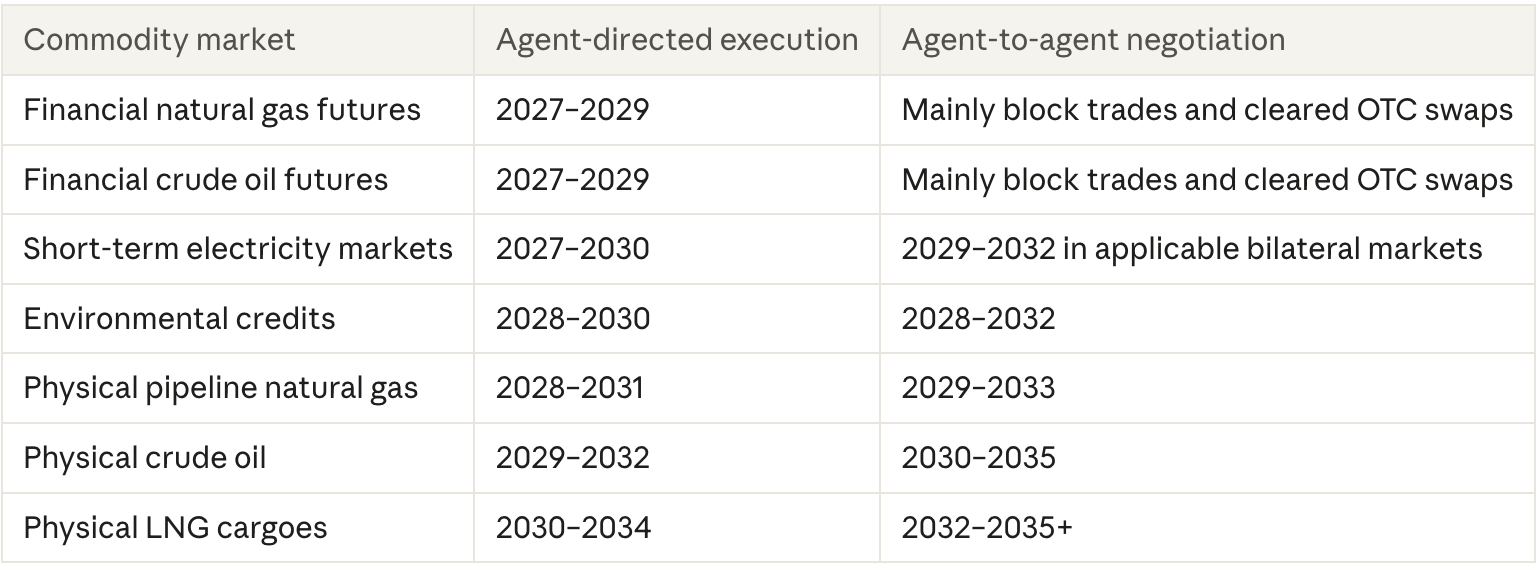
These are our own estimates, not industry forecasts. They represent when meaningful commercial activity could emerge, not when autonomous trading becomes dominant.
Financial futures should lead on execution because contract standardization and electronic trading infrastructure are already mature. Physical markets follow as transportation, delivery, credit and negotiated terms come into play, with LNG the most complex of all.
Why environmental credits deserve attention
Environmental credits are the one market in the table where agent-to-agent negotiation could arrive as early as agent-directed execution.
Many environmental markets remain fragmented, with intermittent trading and limited transparency.
That is precisely where agents could make a substantial difference.
Imagine a company authorizing an AI agent to accumulate eligible compliance credits over several months, within established price and budget limits.
Other companies' agents could continuously offer surplus credits.
A marketplace would facilitate discovery and execution while independently checking credit eligibility, counterparty authorization and relevant registry requirements.
In a market like this, agent-to-agent trading could have a proportionally greater impact on liquidity than in financial futures markets that are already highly automated.
The next evolution of commodity markets
Important challenges remain around reliability, authorization, risk management, market integrity and the complexities of physical transactions. The transition will be evolutionary.
First, agents analyze markets and recommend trades.
Then they execute standardized transactions within tightly controlled parameters.
Eventually, agents representing different companies discover liquidity, negotiate and transact with one another.
As adoption spreads, we could see substantially more trading activity, broader market participation and integrated cross-commodity trading operations.
That would change not only how commodities are traded, but how trading organizations and marketplaces are structured.
The industry has spent decades building electronic marketplaces to make human commodity traders more efficient. The next challenge is building marketplaces where their AI agents can trade with one another.
The biggest opportunity isn't automating the trading we already have. It's creating the conditions for more trading, more participants and entirely new forms of commodity-market liquidity.